
Your dryer is one of the hardest-working appliances in the house, and it asks for almost nothing in return. A clean lint trap, a little airflow, and it just keeps going. So here is some good news: the single most useful thing you can do for it takes about five minutes, costs nothing, and pays you back in faster loads, a lower energy bill, and a machine that lasts years longer. That is the dryer vent check, and once you know how to do it, you will never wonder about it again.
I am a builder by trade, and I have walked hundreds of homes across Celina and North Texas. The dryer vent is one of those quiet spots almost everyone forgets, not because they are careless, but because nobody ever showed them where to look. Let me show you. By the end of this you will know how to tell if yours needs attention, how to clear it yourself, and why a clean vent is one of the easiest wins in the whole house.
Where the lint actually goes
Here is the part most people miss. The lint trap inside your dryer catches a lot, but not all of it. A steady trickle of fine lint rides the warm, moist air out through the vent duct, the run of flexible or rigid pipe that carries everything from the back of your dryer to the hood on your exterior wall or roof. Over months and years, a little of that lint settles along the way. The duct narrows. Airflow slows. And the dryer has to work harder to push the same warm, wet air out of your clothes.
In our part of Texas, two things speed that up. We run a lot of laundry in big households, and our summers mean towels, sheets, and pool stuff cycling through constantly. The more you dry, the faster lint accumulates. None of that is a reason to worry. It is simply the reason a quick seasonal look is worth your time.
The warning signs your vent is asking for a check
Your dryer will tell you when airflow is restricted, if you know what to listen for. Watch for any of these:
- Clothes take more than one cycle to dry. This is the clearest tell. If a normal load comes out warm and still damp, the moist air is not escaping fast enough. That is restricted airflow, and a clogged vent is the usual reason.
- The top of the dryer feels hot to the touch. A dryer venting well stays comfortably warm. One that runs hot is fighting to move air, and that extra heat is wasted energy.
- The laundry room feels humid or smells faintly musty. If the moist air cannot get outside, some of it ends up in the room. A muggy laundry area is a quiet hint to check the vent.
- The exterior vent flap barely moves. Step outside while a load runs and find the vent hood on your wall or roof. The flap should swing open with a steady push of warm air. If it barely lifts, the run is restricted somewhere between the dryer and the hood.
Any one of these is your cue. Not an alarm, just a nudge to spend five minutes confirming things are clear.
Start a normal load, then walk outside to the exterior vent hood. Hold your hand near it. You should feel a strong, steady push of warm air, and the little flap should stand open. Strong flow means you are in great shape. Weak or no flow means it is time to clear the run. That one observation tells you almost everything, and it takes less time than folding a single load.
How to clear it yourself
For most homes, this is a Saturday-morning job you can absolutely handle. Here is the builder's version, start to finish.
Unplug the dryer and pull it out. Give yourself room to work behind it. If you have a gas dryer, take care with the gas line and do not strain it, just ease the unit out far enough to reach the duct.
Disconnect the duct and vacuum both ends. Loosen the clamp, pull the flexible duct off the dryer and the wall, and vacuum the lint out of the duct, the dryer's exhaust port, and the opening in the wall. You will be surprised how much comes out the first time, and a little satisfied too.
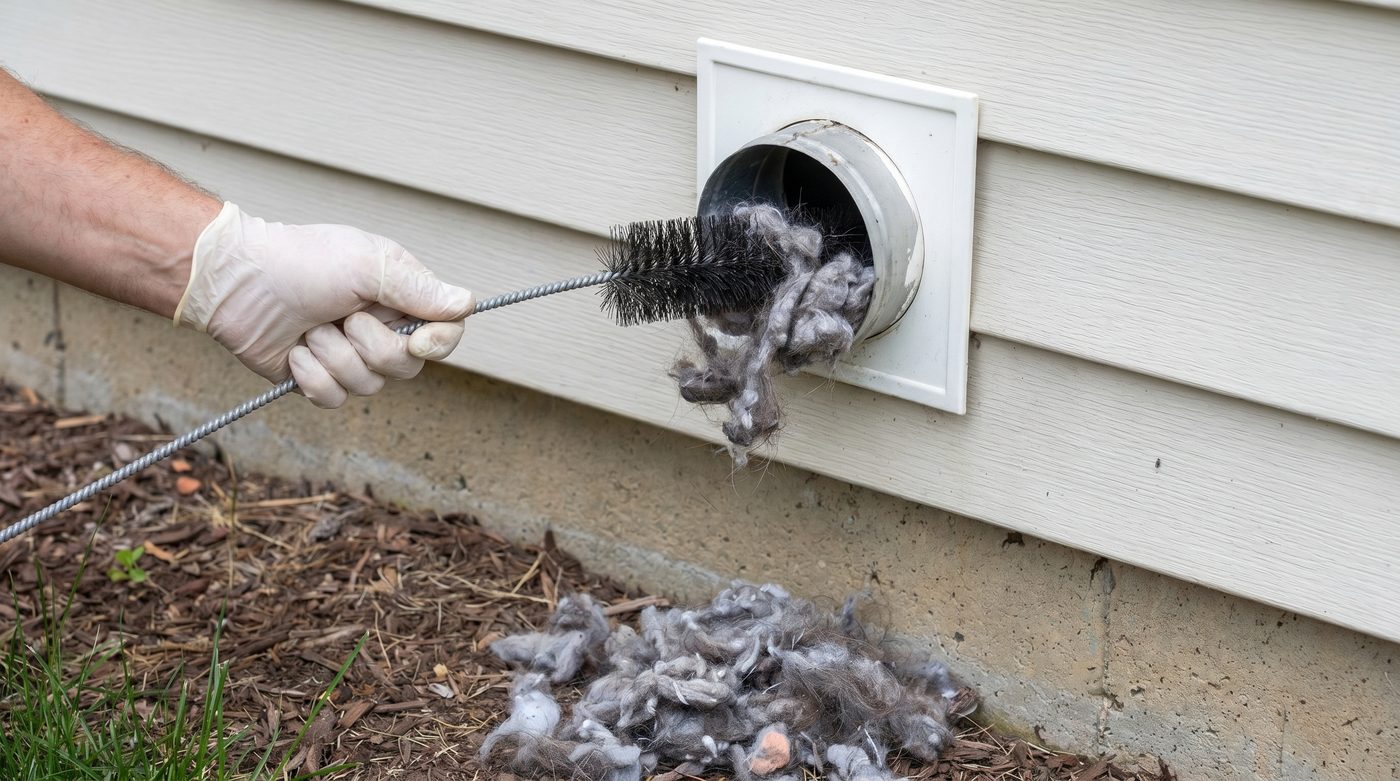
Reach deeper with a brush kit. A simple dryer-vent brush kit runs about twenty dollars and chucks into a drill, so you can spin it through the duct run and knock loose anything packed further in. Vacuum what it pulls back.
Clear the exterior hood. Outside, lift the flap, pull out any lint or nesting material, and make sure the flap swings freely. That hood is the finish line for all that air, so it is worth a good look.
Reconnect and test. Slide everything back together, plug in, run a quick load, and feel that strong push of air outside. That is the payoff, and it is a genuinely good feeling.
The APEX Home Warranty Protection Checklist puts the dryer-vent check alongside 30+ other quarterly and seasonal tasks, organized by season and system. Free, no fluff, written by a builder.
The payoff is bigger than you think
A clear dryer vent quietly improves your whole laundry routine. Loads finish in one cycle instead of two, which means less time waiting and less energy spent per load. The dryer runs cooler because it is not fighting restricted airflow, and a machine that runs cooler tends to last noticeably longer before it ever needs replacing. Add it up and you get faster laundry, a lower bill, and an appliance that earns its keep for years more. All from a five-minute habit.
There is a real safety upside too, and it is worth saying plainly without dressing it up. Lint is flammable, and a dryer is a source of heat. Keeping the vent clear is simply good practice, the same way you change smoke-detector batteries and keep the area around your water heater clean. It is not something to lose sleep over. It is something to handle on a calm Saturday so it is never on your mind again. It is one of the small checks most homeowners skip, and one of the easiest to start doing.
When to call someone in
Most homes are a comfortable do-it-yourself job. A few are worth handing to a pro: a long duct run with several turns, a vent that terminates up on the roof, or rigid duct buried inside a wall where you cannot easily reach it. In those cases the right tools and a second set of eyes make the difference, and there is no shame in passing the harder version along. The same goes for any season where life is just full. A clean vent is also one of the quiet levers on your summer energy bill, so it pairs naturally with the rest of your warm-weather tune-up.
The best home maintenance is the kind that takes five minutes and saves you a season of wondering.
That is really the whole point. You do not need to be a builder or a fanatic. You just need to know where to look, and now you do. Walk outside next time a load is running, feel for that strong push of warm air, and you will know exactly where your dryer stands.
Welcome to the journal. New posts every day.
Our Summer-Ready Tune-Up is $149 and the dryer-vent safety check is built right in, free, alongside a full A/C clean and free in-app documentation of your home's systems. I do the work myself, on time and in uniform, and if you are not 100% happy with the visit, it is free. One relaxed visit and the things most homeowners put off all year are simply handled.
Book the Summer-Ready Tune-Up →